After a few weeks with no new work, I decided to change things up a bit with a quick and dirty little colored pencil picture. Anyone who is familiar with the world of Pokemon knows about Snorlax, the Sleeping Pokemon. While world famous for eating and sleeping, Snorlax can also learn the technique surf to ferry the player across water in the Pokemon games. So in the spirit of summer, I decided to make a little sketch of Snorlax hanging ten.
Particular challenges in this project were portraying the transparency of the wave, and the water shining on the surfboard.
In Chinese and Japanese mythology, it is said that if a carp swims upstream and climbs a certain waterfall, known as the Dragon’s Gate, he will be transformed into a Dragon. This legend has made the carp (also called koi fish) into a symbol of perseverance. The koinobori is a kite shaped like a carp that is flown on Children’s Day in Japan. Blowing in the wind it resembles a carp swimming upstream and is meant to express the hope that the children will grow up with the strength of the dragon.
This legend is the source of the seemingly bizarre relationship between Magikarp and Gyarados in the Pokemon universe. Magikarp is an infamously weak koi fish Pokemon which if trained to level 20, through the perseverance and persistence of the trainer, becomes the powerhouse dragon Pokemon Gyarados. The in-game technique of waterfall, used to swim up waterfalls and usually earned by the player late in the quest, is probably also a reference to this legend.
Speaking of Gyarados, why is this Pokemon, which clearly looks like a dragon and is based on a legend of a dragon, not a dragon type? And why does it gain the disadvantageous addition of flying type when evolving from the pure water typed Magikarp? I, like others, suspect that Gyarados was intended to be dual typed water/dragon. I imagine this was changed at the last minute due to type weaknesses and resistances; dragon was only weak to two types: ice and itself, while the second type of water resists ice attacks. This would leave Gyarados vulnerable only to dragon type attacks, which in the first generation of Pokemon games consisted solely of “Dragon Rage” (which does set damage and doesn’t take weakness or resistance into account) thus making Gyarados invincible.
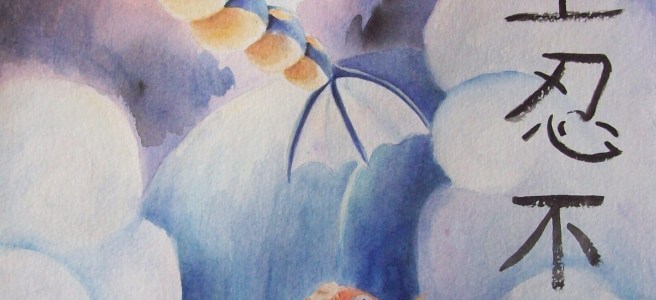
Below is my interpretation of the legend of the Koi and Dragon featuring Magikarp and Gyarados. The Japanese Kanji is read “ken-nin-fu-batsu” and translates to “indomitable perseverance or invincible fortitude”
Perseverance: Magikarp and Gyarados 11″x14″ watercolor Kanji reads “kenninfubatsu” or indomitable perseverance
What does the word unicorn mean to you? Unicorns abound in popular culture, oftentimes as symbolizing little girls, imagination, or fantasy land. For many people, the unicorn carries connotations of femininity and even silliness.
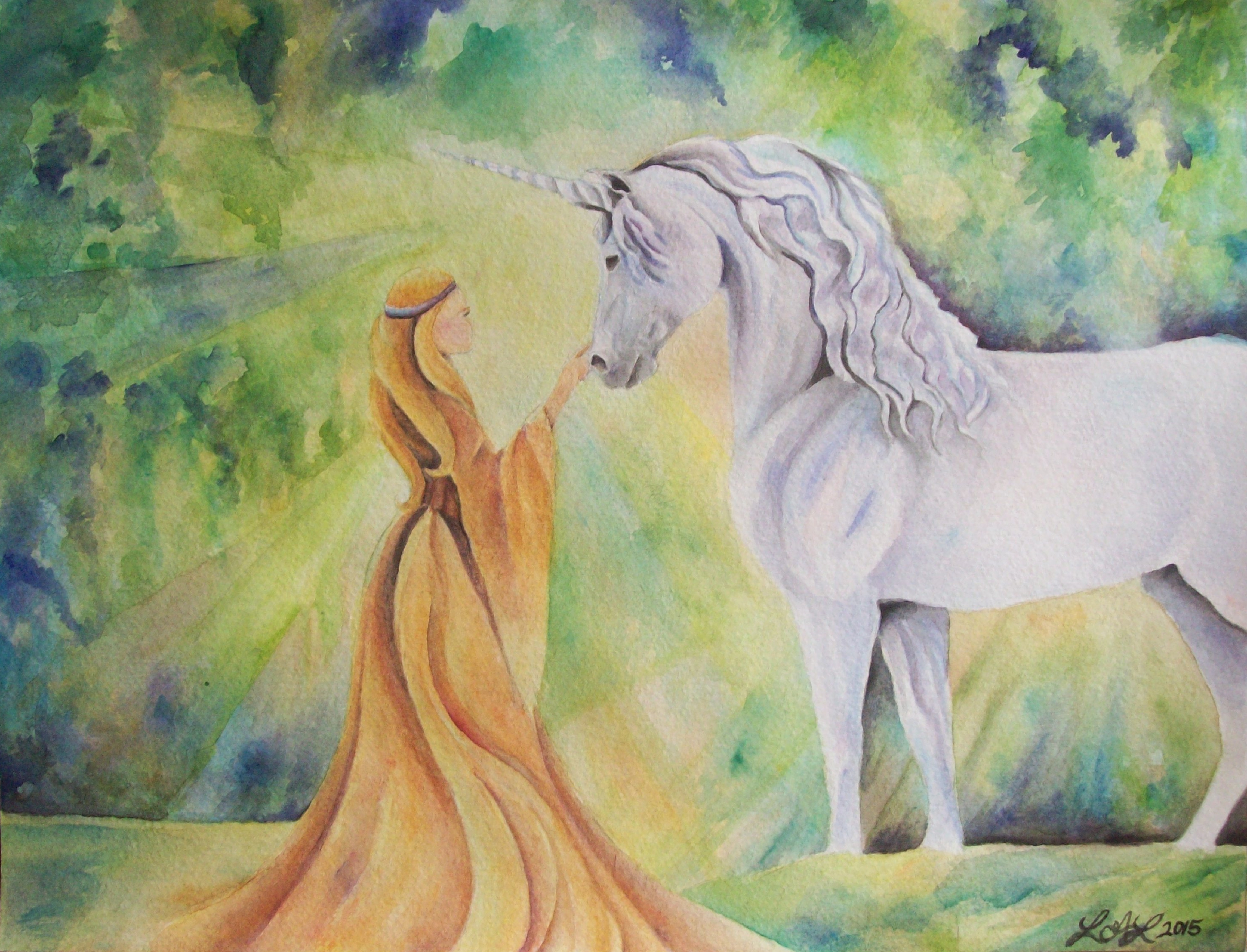
Ancient legends see the unicorn as a symbol of purity. He is shy. He lives in the deepest reaches of the forest and will only allow himself to be seen or handled by a gentle maiden. Sometimes he has the power to purify polluted water with the touch of his horn.
To me, the unicorn represents the soul of nature, and also the soul of horses. His body is large and powerful, but his spirit is noble, wise, and gentle. He will only show his true self to a person that is calm, honest, and does not wish to make use of him. He is to be appreciated, not to be owned. If you are luck enough to see this unicorn, it is a blessing to be cherished.
Tell me in the comments, what does the unicorn mean to you?
One of my favorite things about working on the farm is the opportunity to observe wildlife. On any given day I am likely to see the majestic flight of a heron, the distant soaring of a hawk, or the lively acrobatics of barn swallows.
The other day, I was combing the pasture in search of useful stones for the garden. As I crossed the threshold from grass to trees, I flushed a robin from her post in a small hawthorn tree to a branch about 10 feet away, where she proceeded to chatter incessantly; probably trying to draw me away from her nest. I continued on to the creek-side, where closely cropped grass and distinctly hoof-shaped impressions in the mud betrayed the presence of the equine creature that pretend to be so afraid of this area. Resting on the sunbathed sedges on the bank of the creek were some small frogs, which leapt into the creek with a plop at my intrusion.
Heading back up the hill, I came to the cool, mossy area which contained the loose stones I’d been in search of. As I began collecting, I uncovered a shiny creature, no bigger than my little finger, The Salamander.
“Salamander” watercolor painting, original size 6″x6″





 Laurel Anne Equine Art